Research
We study how structure shapes function in artificial and biological neural networks.
With a focus on how the brain combines information across senses (multisensory integration).
Below are summaries of our key publications.
Partial recurrence can enable robust and efficient computation
Partial recurrence can enable robust and efficient computation
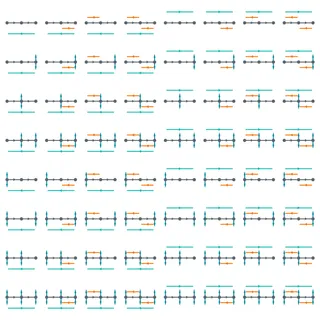
A common feature of neural circuits is that they are sparse (contain few connections) and bidirectional (signals flow from A to B and back). To understand how this structure shapes circuit function, we designed an artificial neural network model which can simulate circuits with different levels of sparsity and bidirectionality. We then compared 128 unique circuits using different functional measures. Our results demonstrate that sparse, bidirectional networks, like those found in the brain, are energy-efficient, yet capable of rapidly learning robust solutions to complex tasks.
Not playing around: why neuroscience needs toy models
Not playing around: why neuroscience needs toy models
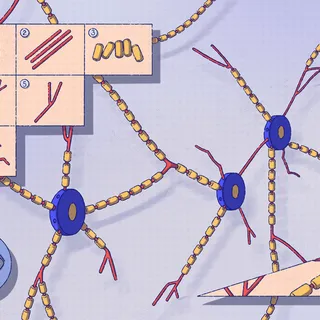
There is a trend towards building bigger, more 'brain-like' models in NeuroAI. For instance, one recent model uses 70 billion parameters to perform simple psychophysics tasks. At this scale, these models are almost as complex, and challenging to interpret, as their biological counterparts. By contrast, smaller 'toy' models, with say 2 to 3 neurons, offer a highly interpretable and practical framework for studying neural circuits. We argue that toy models remain essential, and may be all neuroscience needs.
Ten simple rules for navigating AI in science
Ten simple rules for navigating AI in science
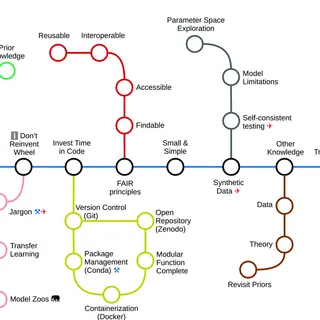
Methods from artificial intelligence are increasingly being leveraged by scientists. As researchers using AI in diverse fields, from particle physics to plant biology and neuroscience, we wrote this didactic article to suggest how scientists can make the best use of AI methods.
Fusing multisensory signals across channels and time
Fusing multisensory signals across channels and time
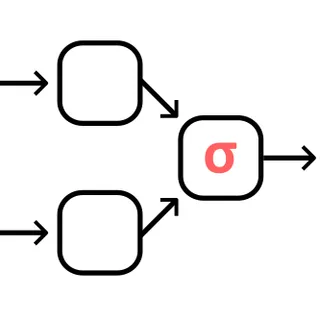
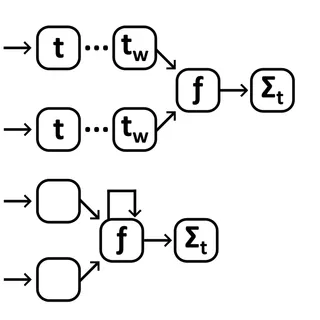
Many sensory signals are naturally structured in time: picture a mouse darting from cover to cover as it tries to escape a predator. Yet, most computational models are blind to this structure (as they treat successive observations independently). To illustrate this, we simulated predator-prey scenarios with time-varying dynamics and showed that prior models perform poorly in these settings. Motivated by this, we introduce a new set of models which describe how animals could fuse sensory signals across time. Surprisingly, we find that combining signals across senses and short periods of time, works as well as a more complex model.
Spiking neural network models of interaural time difference extraction via a massively collaborative process
Spiking neural network models of interaural time difference extraction via a massively collaborative process
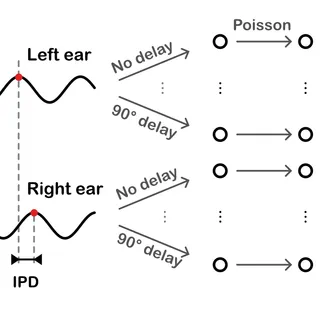
How should we structure large-scale scientific efforts? Massively collaborative projects, which anyone, anywhere, can contribute to, are one option. We ran a computational neuroscience project like this for 2 years and, here, share our results and experiences. At a scientific level, our work investigated how networks of simulated neurons can localize sound. At a more macro-level, our project brought together 31 researchers from multiple countries and provided research and training opportunities. Overall, our work demonstrates the potential for massively collaborative projects to transform how science is structured.
Nonlinear fusion is optimal for a wide class of multisensory tasks
Nonlinear fusion is optimal for a wide class of multisensory tasks
How should animals combine the signals from their different senses? Many prior studies suggest that fusion should be linear (e.g. sight + sound). In this work we developed a set of computational models and a simple simulation of a predator-prey scenario. Using these, we demonstrated that linear fusion would be suboptimal in many scenarios and would even fail in extreme cases. This led us to propose a new, nonlinear algorithm f(sight, sound) and to demonstrate how it could be implemented in vivo, using simulations of spiking neural networks.